Monday, March 12, 2012

Chirish Eats

Tonight we attended a fun, fascinating Science Cafe about epigentics, put on by the Pacific Science Center and held at the Wilde Rover Pub. Boxty, beer, and biology - you can't beat that, really! 

In celebration of the upcoming St. Patrick's Day, here's a recipe for what we call kong-cannon.

Kong-cannon is part of a balanced meal. Here, it accompanies veggie meatloaf and some unidentifiable purple/green stuff. 

This is a colcannon (Irish potato, cabbage, and scallion skillet) recipe from Nava Atlas' Vegetarian 5-Ingredient Gourmet, altered for the Chinglish (Chinese and English family) household. We typically serve this with veggie sausages (Field Roast apple sage is our favorite - according to Field Roast's marketing material, they're a "blend of English and Asian heritage", whatever that means) and beer (your choice - British or Chinese beer).

4-6 servings

  • 4 large potatoes (Alan, the English half of the Chinglish household, thinks there should be more potatoes in this recipe)
  • 1.5 tablespoons light olive oil
  • 2.5 cups of chopped Napa cabbage
  • 5 Shiitake mushrooms (optional)
  • 6 scallions, white and green parts, sliced
  • 1 handful of chopped cilantro
  • 1 cup milk or soymilk
  • Salt and freshly ground pepper to taste

  1. Bake, boil, or microwave the potatoes in their skins until done. When cool enough to handle, peel, and coarsely mash.
  2. Heat oil in a large skillet. Add the cabbage and saute, covered, over medium heat, stirring occasionally until limp. Add scallions and mushrooms and saute, uncovered for about 4 more minutes. If the skillet becomes dry, add small amounts of water as needed.
  3. Add the potatoes, cilantro, and milk, stir everything together, and turn the heat up to medium-high. Cook without stirring until the bottom of the potato mixture gets nicely browned. Fluff with a wooden spoon, season with salt and pepper, and serve.

Monday, February 13, 2012

Safari in Sandusky

Jen and I attended a software development conference recently, and it was a wonderful combination of techno-geekery, education, and fun!

The conference is called CodeMash and was started by developers who were jealous of the developers on the coasts who have lots of conferences to attend in San Francisco, LA, Seattle, New York, Boston etc. They then decided to make their own that was central for developers in Cleveland, Columbus, Dayton, Cincinnati, Pittsburgh etc.

The organizers wanted to keep the cost as low as possible but needed a large hotel and meeting rooms. They found the perfect location in the Kalahari Resort waterpark and kept the costs low by having the event in January. Yes, a water park, in Ohio, in January!

Everything was African themed in a delightfully tacky way - from the decorations and furniture in the rooms to the huge poster hanging on the apartment complex next to the hotel.
The conference was very well-organized, and the sessions covered a great range of software development topics. I suppose this conference is not to everyone's taste but we thoroughly enjoyed it by cramming in as much info as we could and attending the parties as well.

You can tell that it is Sub-Saharan Africa by the elephants and 2 inches of snow on the ground.


The bar was full of "exotic" animals, and the food had a flavor that might be fusion cuisine (a fusion of African and Midwest America; mostly Midwestern meat and potatoes, to be honest).


Highly recommended to anyone who wants to hang out with 1200 software engineers in their bathing costumes!

Some highlights of the conference:

The other photos can be viewed by following this link.

Sunday, October 24, 2010

Planes, Trains & Automobiles... Camels & Elephants, Too!

After experiencing the lovely variety of transport methods in Asia, driving a car in the USA just won’t be the same.

After our long flight to Kathmandu, Nepal, we walked a little to get the circulation back in our legs.
Alan on the first day of a 23-day, 250+ km trek around the Annapurna massif and into Annapurna Sanctuary in Nepal.
The public bus system rivals that of Orange County, California.
Bus on a Nepali road.
We got front row seats on the flight.
Paragliding above Sarangkot, Pokhara, Nepal.
The comfortable taxis are delightfully decorated.
No seatbelts on this scary ride , but we've got Avril Lavigne.
The boats got us where we needed to be.
Dawn boat ride in Varanasi, India.
Elephants and camels yield surprisingly great grass mileage.
Alan and Charlie Camel riding into the sunset near Jaisalmer, India.
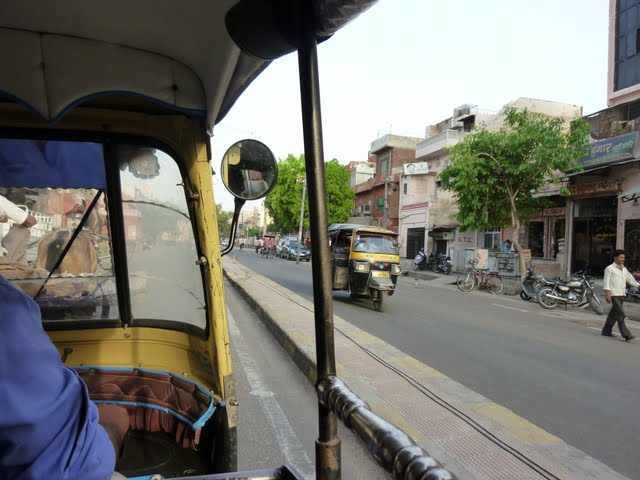
Even Jennifer would be able to drive a tuk-tuk.
Riding an auto rickshaw in Jaipur, India.
Jennifer survived her first-ever tandem bike ride with Alan.
Alan and Jennifer's first and last tandem bicycle ride (on the Xi'an city walls).
The trains were well-equipped with anything a passenger might fancy.
Beijing-Lhasa high-altitude train outfitted with oxygen outlets at each seat.
We got some decent scenery on our drive back into Nepal.
The Land Cruiser in front of Everest and its siblings. Our Tibetan driver was fearless on the icy roads.
Many thanks to our amazing, death-defying { paraglider, bus, taxi, elephant, camel, train, boat, tuk-tuk, Land Cruiser } drivers that got us safely back!

Saturday, October 23, 2010

Blending In

No one wants to look like an obvious tourist, so here are some examples of how to blend in with the local people and not stand out as a foreigner. We employed the techniques below with varying degrees of success (varying from "none" to "laughably poor").


Jen helps a local wash an elephant. (Chitwan National Park, Nepal)
Learn the correct eating customs and adapt to local "furniture". (Sauraha, Nepal)
Keep up with new fashion trends / deadly outbreaks. (Swayambhunath Temple, Kathmandu, Nepal)

Be polite and wave to the masses. (Amber Fort, Jaipur, India)
Befriend people with common interests. This lass had never heard of Orange County, CA even though she was wearing a shirt from there. (Sauraha, Nepal)
If farmers need help, pitch in like a villager. (Sauraha, India)
Don't worry if the shops don't have quite the right sizes. (Jama Masjid, Delhi, India)
Alan shows correct dress sense at the Golden Temple. (Amritsar, India)
Don't freak out if the restaurant is a little "different". (Golden Temple, Amritsar, India)
If the weather is hot, wear a hat like everyone else. (Jodhpur, India)

Other headgear choices allowed us to travel incognito in China. (Jinshanling, China)


Finally, Jen demonstrates how to not blend in by eating at McDonalds in Jodhpur, India.

Thursday, July 15, 2010

Back in the USA

We are back safely in the USA after an amazing 4 ½ months.

Clearly our plan of blogging regularly while on the trip failed badly once we reached The Great Firewall of China. It took much more effort and time than we thought it would and Jennifer was horrified that some of the Internet Cafes in the developing world were not running Windows 7 or multicore hardware ;)
Anyway, we have started going through the 4000 photos we took and should be posting regularly within a day or two.

Monday, April 19, 2010

The Pink City

The city of Jaipur is called 'The Pink City' because some past ruler of the town decreed that all buildings within the old city must be painted pink. And you thought your landlord / HOA restrictions were harsh?

We had a laundry list of things to see and do (aside from laundry).

The main attraction for us was Amber Fort, pronounced Am-beer. The fort's size is staggering considering its age. Like most similar places around the world, it was built in stages. Then after several hundred years of construction the owner decided that he liked the location a few miles down the valley, and the new city was built while Amber was left in ruins. Thanks to tourist dollars, it has been restored. We spent hours exploring the rooms, corridors, and courtyards.

Amber Fort
I think our rickshaw driver, who waited patiently in the mid-day sun for us, was cursing himself for agreeing to a "no-waiting charges" deal. Alan is such a shrewd negotiator knowing that Jen tours museums at about half the speed of a normal tourist. That poor driver earned every Rupee today.

We also spent several hours in the Observatory Park that has giant structures created to measure the angles of stars and our Sun and a full set of 12 astrological instruments that are used depending on which zodiac sign is in play.
Astronomy device for measuring position of stars
Huge sundial, accurate to 2 seconds!

The City Palace had a few objects of interest. The most memorable are two vast silver water containers that were used on a trip to England by the head of state. He carried Ganges water all the way to London so that he could wash in it every day to stay clean. Remember from our Varanasi post that the Ganges is one of the most polluted rivers in the world, and you might be as baffled as we were as to why anyone would transport even a small vase of it anywhere else, let alone 40,000 gallons in two silver vats.


The food in Jaipur was exceptional, though we stayed away from the street vendors and went to only restaurants we found in our bible: The Lonely Planet. Alan hasn't eaten this much curry since his student days in London's suburbs. Unfortunately, samosas are nowhere to be found in the restaurants we deemed safe to eat at. The waiter laughed at us and called it street food when we asked for them. Oops. We haven't been able to conjure up the courage to eat from the street vendors yet.

Train

After the ride to the border which involved 5 hours sitting on a sweltering bus that had been advertised as air conditioned, we decided that the train was the comfortable, safe way to travel.
The photos you may have seen of overcrowding on the trains do not apply if you pay a little extra for "AC" class.
Thankfully this was not our train
 It was a little difficult for Jennifer to sleep but Alan had no problem catching some zzzz's. This will be our preferred method of transit from now on.
Trying to figure out the timetable book on board a sleeper train

Toto, I've a Feeling We're Not in Kansas Anymore...

Lumbini was the last town we visited in Nepal. Seeing the very spot that Buddha was born was a tad anti-climatic, but it's probably because I'm not Buddhist or Hindi. Most of the stupas there were beautiful and elaborate, some of them bordering on ostentatious.

We crossed the Nepal/India border the following day in Sunauli. People are correct when they say it's not a place to linger, being a typical border town. We decided to stay in the night in Gorakhpur instead of arriving into Varanasi late at night. Gorakhpur was not pleasant, but it was a good decision. If we had arrived in Varanasi at night, I think we would've hightailed it back across the border to Nepal.

Having heard the wild tales from fellow travelers on the Annapurna treks regarding Varanasi, we were a bit scared of the city. American writer Mark Twain wrote: "The city is older than history, older than tradition, older even than legend, and looks twice as old as all of them put together."

One hiker we met described it as the filthiest place on the planet, and certainly it has more than its fair share of dung, pee, garbage, and rotting food. Also, it's a place where Hindu pilgrims go to die as there is some get-out-of-jail-free card if you die here. If you are "lucky" enough to pass away here, you can be cremated in full sight of boats on the river. The smoke from about 50 funeral pyres per day certainly doesn't ease the air quality problems.

The Ganges River is used daily for devout Hindus to bathe themselves, as they believe it cleanses the spirit. It may cleanse the spirit, but it certainly does not cleanse the skin. The Ganges is one of the most polluted rivers in the world. There are 14 million people living upstream and not one single sewage treatment plant. The river has at times 65,000 times the safe level of fecal matter floating in it.

The beautiful waters of the Ganges

Having said all that, the city was not as bad as it may sound. The Ganges water didn't look or smell as dirty as we had thought it would, and the city was only slightly dirtier than some of the Nepal cities we had visited.
There is quite a lot to see if historic buildings are your thing, and the religious ceremonies at the river bank ghats in the evening were a good spectacle - lots of bell-ringing, chanting, and waving fiery objects around.

River bank during the day

River bank during night-time ceremony

The accommodation was fairly nice, but the owner and the many helpers employed there gave it a very odd vibe. There was a feeling that we were under constant surveillance to make sure that all the money we spent was funneled through the hotel. They offered to walk with us to show where the nearest internet cafe was, even though there were several within a few minutes' walk. Almost every time we saw someone in the hotel, they asked if we had our train tickets booked or if we needed an Ayurvedic massage. Despite our constant refusal of their "help," the lure of a little commission seemed to affect their hearing.

Next stop is Jaipur...

Sunday, April 11, 2010

Lions and Tigers and Bears - Oh, My!

Chitwan National Park in Nepal was our next destination. After a very exciting bus ride down a typical Nepali road (involving an exhaust getting knocked off, the bus engine not being able to start again, and some other various miscommunications with the bus driver), we finally arrived at Island Jungle Resort. We were able to at least watch an awesome sunset.


Early the next morning, we saddled up an elephant to go "interact" with the local wildlife.

Getting ready for the morning commute
Rhinos, wild boars, and langur monkeys were going through their morning ablutions and eating breakfast.


The tranquility of the jungle was only disturbed by 20 people riding 4 elephants trampling through the thick brush. Really, the rhinos didn't seem to mind.

Afterwards, we walked through the jungle with a local tracker to try to find tigers and sloth bears, only the most feared animals in Chitwan. No, this doesn't sound smart to me either. The weapon of choice held by our tracker and guide: a big stick. We saw neither of these beasts, but did see tiger paw prints and sloth bear pits in the mud where they forage for termites. We were instructed to run up a tree if confronted by a rhino.

The elephant and Alan worked up quite a sweat walking (it was only about 36C/97F), so they both decided to take a bath in the river. 
An elephant sneezes on Alan.
The national park was relaxing and tranquil, but we wanted to learn a bit about the Tharu people who used to live in the area that is now the park. Most of the Tharu now live in the areas surrounding the park in Sauraha. We learned that the Tharu are descendants of the Rajasthani tribes who migrated to the area. (We're currently in Rajasthan in India, and we do see some of the similarities in the customs.)

Hot as it was, we rented two bicycles to explore the local Tharu villages. Most Tharu people's mode of transportation is bicycle, not elephant, not car.

Jennifer and her trusty steed. Check out the cool brakes and bling on the bike. Just needs tassles on the handlebars.
In the evening, we visited a local Tharu family to learn how to cook a typical Tharu meal. Guess what we cooked - dal bhat!! Sapana Village Lodge organized this for us, and it was definitely a highlight for me.

It's actually a pretty sweet deal for the family. We pay them money to prepare an entire meal for them. But honestly, we learned a lot and had fun. Hopefully they had as much fun as we did (I think Alan provided some nice evening entertainment) and enjoyed the meal we cooked for them.

Alan stirring the onions while sitting on a Nepali-sized stool. The Tharu ladies laughed each time he had to stand up to stretch. Poor Alan.
Alan plants some rice. He needs to go back in a couple of months to harvest now. Rice planting is typically done by the women. Yes, the little kids are laughing at Alan. Poor Alan.

Post-Trek Play and Preen in Pokhara

With the trekking part of our trip completed at the end of March, it was time to go to the mountain town of Pokhara for a well earned shave and head massage. This was Alan's best shave in years.


Then we went to the International Museum of Mountaineering that contains an exciting rock collection.


and a scale(able) model of Manaslu. It was treacherous. White paint on rocks is suprisingly slippery!

The closest Jennifer will ever get to climbing an 8k+ meter peak.
The museum closed early because, we were told, the prime minister of Nepal had been killed! It turns out the an ex-prime minister had died of old age a few days before. It was at about this point that we realized we had not seen a newspaper for nearly a month. We pondered whether everything in the homeland was still OK and had another beer.

We plucked up courage to try paragliding as Pokhara is one of the best sites in the world for it. The feeling of running off the side of a cliff is exhilarating. We circled on thermals following hawks and then the pilot performed some acrobatics before landing by the lake. Jennifer's pilot let her take control of the wing for a few minutes and everyone survived to tell the tale.

Jennifer can barely drive a car. How can she fly?

Monday, March 22, 2010

The Dal Bhat Challenge (aka Annapurna Circuit)


Nearly a month ago, Alan and I started the Dal Bhat Challenge. The goal: eat dal bhat (Nepal's national dish consisting of lentils, rice, and vegetables) everyday after walking long distances each day. Whose digestive system will reign supreme?

Yes, that's a YakDonald's in Kagbeni!
OK, the primary goal wasn't to determine whose stomach could handle the endless days of white rice. It was to trek the Annapurna Circuit, frequently deemed as one of the "classic" treks. It's approximately 128 miles long and traverses diverse terrain, from sub-tropical through alpine to an arid semi-desert akin to Tibet. The route goes through villages, so there's an opportunity to meet the different people living in the region as well as stay in a cozy (or really not so cozy, especially at 14,530 feet elevation) lodge each night. We would also get to 17,768 feet which would be the highest we've ever been. In a nutshell, it's the ultimate hike!


Why try to eat dal bhat everyday?

1) It really is yummy. Each family has their own secret recipe.
2) It's safe to eat. Nepalis eat it everyday, so there's high turnover of the ingredients. It's piping hot, so any nasties should have been killed off.
3) 24 hour power! Porters and guides love to eat the stuff, and they carry amazing loads at superhuman speeds. If it's good enough for them, it should be good enough for us, right? It's also all-you-can-eat, so it's perfect for those long days on the trail.

Sunrise at Annapurna Base Camp
So, you ask, who won the challenge...

Jennifer's DB count: 10
Alan's DB count: 7

Um, we were on the trail for a total of 23 days, so yeah, neither of us could keep it up for very long. You would think with my genetic makeup (my ancestors were all voracious rice eaters, after all) I would easily beat the Englishman.

Even though we both lost the DB challenge miserably, we both enjoyed the trail immensely. We loved the trail so much, we ended up extending it by adding the Annapurna Sanctuary trek to it. Not only did we see the most beautiful mountain scenery, we both got to meet the most interesting, intriguing people (locals, as well as fellow trekkers from around the world) and learn from them. Where else would you be able to learn how to race goats through narrow alleyways or how you would describe Baywatch to a mountain guide who has only ever lived in a landlocked country?

Kids attacking us on the trail on Holi